23 Best, Proven Wins: Interval walking plan for faster fat loss (Best for Real-World Results)
Comprehensive Outline for “Interval walking plan for faster fat loss”
| Section | Heading / Subheading |
|---|---|
| Intro | Interval walking plan for faster fat loss: why intervals work |
| Core Answer | Best for beginners to advanced: interval walking plan for faster fat loss |
| Physiology | How intervals increase EPOC, fat oxidation, and calorie burn |
| Zones | Heart-rate and RPE zones for an interval walking plan |
| Cadence | Steps-per-minute and pace targets for intervals |
| Gear | Best shoes, belts, and watches for interval walking |
| Warm-Up | Dynamic warm-up before an interval walking plan for faster fat loss |
| Template A | Beginner “walk-run feel” without running |
| Template B | Best for busy days: 20-minute express intervals |
| Template C | Incline power-walk intervals on treadmill |
| Template D | Outdoor hill repeats for fat loss |
| Template E | Hybrid cadence + incline day |
| Weekly Plan | Four-week interval walking plan for faster fat loss |
| NEAT | Non-exercise steps to multiply results |
| Strength Pairing | Two quick strength circuits that amplify fat loss |
| Recovery | Mobility, sleep, and low-intensity days |
| Nutrition | Protein, fiber, and pre/post-walk fueling |
| Hydration | Electrolytes and heat/cold strategies |
| Plateaus | Best for breaking stalls: progression knobs to turn |
| Safety | Joint-friendly cues & contraindications |
| Tech | Tracking with HR, cadence, and apps |
| Environments | Treadmill vs outdoor: which is best |
| Mindset | Habit loops, streaks, and micro-prompts |
| FAQs | FAQs: interval walking plan for faster fat loss |
| Mistakes | Common errors and fast fixes |
| Conclusion | Final rules you’ll actually follow |
Interval walking plan for faster fat loss
Let’s cut to the chase: if you want more results in less time, an interval walking plan for faster fat loss is the most sustainable upgrade to a regular brisk walk. By alternating challenging bouts with easier recovery, you raise your average intensity without needing to jog, jump, or trash your joints. It’s the best bridge between “I walk sometimes” and “I consistently lose fat and keep it off.”
You’ll get precise pace, cadence, and heart-rate targets, plus multiple plug-and-play templates—so you can pick what’s best for your schedule, fitness, and environment (treadmill or outdoors). Add a few cheap tools and a steady routine and you’ll notice fitter lungs, firmer legs, and steadier appetite—without shin-splint drama.
Best for beginners to advanced: the quick-start interval walking plan for faster fat loss
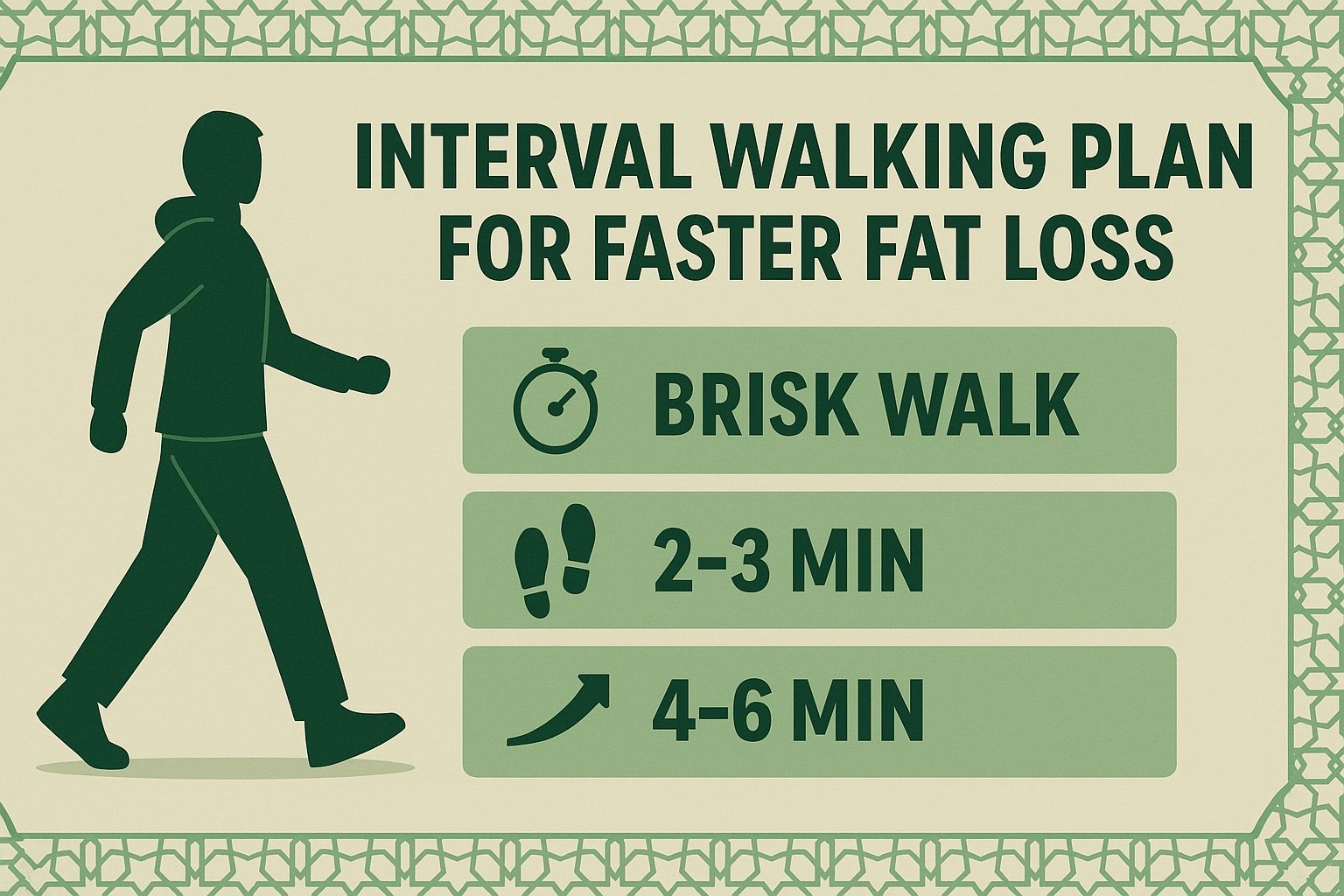
- Frequency: 3 interval sessions per week (non-consecutive), plus 2–3 easy-step days.
- Duration: 20–35 minutes per session, including warm-up/cool-down.
- Intensity anchors:
- Work bouts: RPE 6–8/10 (breathing hard, can’t chat comfortably).
- Recoveries: RPE 3–4/10 (able to talk).
- Targets:
- Cadence: 110–135 steps/min during work, 90–105 during recovery.
- Heart rate: ~70–85% HRmax during work, ~55–70% during recovery.
Pick one template below and repeat it for two weeks before progressing.
Why interval walking burns more: the physiology in plain English
An interval walking plan for faster fat loss leverages three mechanisms:
- Higher average intensity without fatigue blowback—brief pushes raise oxygen use and energy cost.
- EPOC (excess post-exercise oxygen consumption): after a challenging session, your body keeps burning a little extra while restoring balance.
- Muscle recruitment & gait efficiency: faster cadence and inclines engage glutes and posterior chain, improving insulin sensitivity and daily burn.
You get more total work in the same time window—a best for busy schedules advantage.
Heart-rate & RPE zones for an interval walking plan for faster fat loss
Estimate HRmax ≈ 220 − age. Use these ranges:
- Zone Easy (Recovery): 55–70% HRmax (RPE 3–4)
- Zone Brisk (Work): 70–85% HRmax (RPE 6–8)
Example age 40 → HRmax ~180 bpm:
- Recovery 100–125 bpm; Work 125–153 bpm.
If you don’t track HR, the talk test works: during work you can say a few words, not a sentence.
Cadence and pace targets (no guessing)
- Work intervals: 120–135 SPM ≈ 3.6–4.2 mph (16–14 min/mile)
- Recovery intervals: 90–105 SPM ≈ 2.5–3.0 mph (24–20 min/mile)
Count one foot for 30 seconds and double, or use a wearable that shows cadence. Cadence is the best for outdoor control where speed fluctuates.
Best gear for interval walking (Amazon examples, non-affiliate)
- Cushioned Walking Shoes: Brooks Ghost / Adrenaline, New Balance Fresh Foam
- Clip-On Pedometer or Fitness Band: reliable steps & HR
- Slim Running Belt: carry phone/keys without bounce
- Reflective Vest: dawn/dusk safety
- Insulated Water Bottle: cold sips, year-round
Proper shoes and visibility gear are best for consistency and comfort.
Dynamic warm-up before your interval walking plan for faster fat loss
Spend 5 minutes:
- 1 minute easy walk → shoulder rolls & tall posture.
- 1 minute ankle circles and calf pumps (on a curb).
- 1 minute leg swings (front/back, side/side).
- 1 minute marching with quick arms (build cadence).
- 1 minute progressive brisk walking to your first work bout.
Warm joints = smoother cadence and fewer niggles.
Template A — Beginner intervals (no running required)
- Total: 22–25 minutes
- Structure:
- 5 min warm-up easy
- 8 rounds: 30 sec work (RPE 6–7, 120–125 SPM) + 60 sec recovery (RPE 3–4)
- 4–5 min cool-down easy
- Best for: new or returning walkers, heavier bodies, post-illness rebuilds.
Progression after 2 weeks: make work 40 sec and recovery 50 sec.
Template B — 20-minute express (best for busy days)
- Total: ~20 minutes
- Structure:
- 4 min warm-up
- 10 rounds: 45 sec work (125–130 SPM) + 45 sec recovery
- 3–4 min cool-down
- Why it works: a compact, high-density session—you’ll finish breathy but not wrecked.
Template C — Treadmill incline power-walk
- Total: 28–30 minutes
- Structure:
- 5 min warm-up at 0–1% incline, 2.8–3.0 mph
- 6 rounds: 2 min at 4–6% incline, 3.4–3.8 mph + 2 min flat, 2.8–3.0 mph
- 5 min cool-down
- Best for: joint-friendly intensity; weather-proof; precise control.
Progression: nudge incline up 1% or pace by 0.1 mph each week you feel good.
Template D — Outdoor hill repeats
- Total: 24–28 minutes
- Find: a hill taking ~60–90 sec to climb at brisk effort.
- Structure:
- 6–8 repeats: power-walk up (RPE 7–8), easy walk down (RPE 3)
- Warm-up/cool-down 5 minutes each
- Note: keep steps quick and short to avoid heel braking.
Template E — Hybrid cadence + incline day
- Total: 26–30 minutes
- Structure:
- 5 min warm-up
- Block 1 (8 min): 60 sec at 130–135 SPM (flat) + 60 sec easy
- Block 2 (8 min): 60 sec at 3–4% incline + 60 sec easy
- Block 3 (4–6 min): alternating 30/30 at choice of flat or incline
- 3–4 min cool-down
- Best for: avoiding boredom; engaging glutes and calves.
Four-week interval walking plan for faster fat loss
Goal: reach 3 interval days + 2–3 easy-step days (8k–12k steps).
Week 1
- Mon: Template A
- Wed: Easy 40–50 min walk (Zone Easy)
- Fri: Template B
- Weekend: Optional 30–45 min easy walk
Week 2
- Mon: Template C (lighter—4 rounds)
- Wed: Easy 45–60 min
- Fri: Template B (10 rounds)
- Sat/Sun: 8–10k steps across day
Week 3
- Mon: Template C (6 rounds)
- Wed: Easy 45–60 min + 10 min mobility
- Fri: Template D (6–8 hills)
- Sat: Leisure walk to hit 10–12k steps
Week 4
- Mon: Template E
- Wed: Easy 40–50 min
- Fri: Template C or D (your choice)
- Sun: Optional recovery stroll; total weekly steps +10–15% above week 1.
Progress by lengthening work, shortening recovery, adding a round, or nudging incline—one change per week.
NEAT: your silent multiplier
Your interval walking plan for faster fat loss does the heavy lifting, but daily NEAT keeps the burn humming:
- 5-minute micro-walk each hour of desk work (≈ 400–700 steps).
- Park farther, use stairs, pace calls.
- 10-minute after-meal strolls improve glucose and appetite control.
Set a step floor: 8,000–10,000 on interval days, 6,000–8,000 on recovery days—best for adherence.
Two quick strength add-ons (10–12 minutes)
Strength preserves muscle and tightens your silhouette.
- Circuit A (upper back & core): band pull-aparts 15, plank 30–45s, dead bug 8/side, repeat ×3.
- Circuit B (legs & hips): sit-to-stands 12, split-squat 8/side, hip hinge with backpack 12, repeat ×3.
Slip a circuit after your easiest walk or on rest days.
Recovery that accelerates fat loss
- Sleep: 7–9 hours—poor sleep raises hunger hormones.
- Mobility: 5 minutes post-walk—calf stretch, hip flexor lunge, thoracic rotations.
- Easy days: nasal-breathing pace, keep cadence low and posture tall.
Recovery keeps you consistent—the best for long-term fat loss.
Nutrition: simple rules that work with intervals
- Protein: ~0.7–1.0 g per lb goal bodyweight.
- Fiber: 25–40 g/day from veggies, legumes, whole grains.
- Carb timing: small carb + protein 60–90 minutes pre-walk if fasted makes intervals feel easier.
- Post-walk: prioritize protein and hydration to curb rebound snacking.
- Portion honesty: log for 7–14 days whenever progress stalls.
Hydration & temperature control
- Hydrate: ~500 ml water 1–2 hours pre-walk, sip during if >30 min or it’s hot.
- Electrolytes: helpful in heat or heavy sweaters.
- Cold/wet: layered clothing; keep hands warm for comfort (cheap glove liners help).
Plateau-busting: the “best for” progression knobs
If your scale or waist stalls for 2+ weeks:
- Add 1 round to your intervals (or make work +10 sec).
- Nudge incline +1%, or cadence +2–3 SPM on work bouts.
- Increase daily step floor by 1,500.
- Trim 150–250 kcal from daily intake (usually liquid snacks or late-night nibbles).
- Tighten sleep to 7.5+ hours.
Small, sustainable adjustments beat crash tactics.
Safety first: joint-friendly cues
- Keep strides short and quick; land under hips (reduces heel braking).
- Maintain a tall spine; let arms swing back-to-front.
- If pain >3/10 persists, drop intensity, swap to flat terrain, or consult a clinician—especially for knee, hip, or foot issues.
- Heavier walkers: prefer incline over speed; it boosts cardio with lower impact.
Tracking tech: simple to advanced
- Budget: clip-on pedometer + phone timer.
- Mid: fitness band with HR + cadence readout.
- Advanced: GPS watch with intervals & structured workouts.
Track cadence, HR, rounds, and RPE notes. This turns effort into actionable data—the best for steady progress.
Treadmill vs outdoor—what’s best
- Treadmill: precision and weather-proof; add 1% incline to mimic outdoors.
- Outdoor: more enjoyment, sunlight, and natural terrain variance.
Use whichever you’ll do most consistently; mix for variety.
Mindset: streaks and micro-prompts
- Put shoes by the door; belt and vest in the same spot.
- Attach intervals to existing habits (after school drop-off, post-lunch).
- Track a streak of days you met your step floor.
- When motivation dips, rely on environment and routine—best for consistency.
Recommended Amazon products to support your plan
- Walking Shoes (Neutral/Stability): comfort that keeps you going
- Treadmill (folding, incline options): interval-ready at home
- Resistance Bands (for strength add-ons): compact and versatile
- Reflective Walking Vest & Headlamp: be seen, be safe
- Insulated Water Bottle: sips that stay cold or hot
- Running Belt / Armband: phone + keys without bounce
FAQs: Interval walking plan for faster fat loss
How many times per week should I do interval walking?
Three sessions weekly with easy steps between is best for fat loss and recovery.
How fast should work intervals feel?
RPE 6–8/10 or 70–85% HRmax; you’re breathing hard, speaking only a few words.
What if I can’t hit the cadence?
Shorten your stride; increase arm swing; use incline to raise effort without over-speeding.
How long until results show?
Energy and mood improve first (1–2 weeks). Visible changes typically show in 3–6 weeks with consistent steps and nutrition.
Are hills better than flat intervals?
Hills or treadmill incline are best for joint-friendly intensity. Flat speed work is fine if your shins and calves feel good.
Can I do intervals daily?
Not recommended for most. Alternate with easy days to protect joints and control appetite.
Common mistakes & easy fixes
- Going too hard, too soon: start with Template A/B; build gradually.
- Overstriding: keep cadence high, steps short.
- Skipping recovery: quality work requires real recoveries.
- Ignoring shoes and surfaces: upgrade footwear; rotate routes.
- No step floor: intervals help, but daily NEAT locks in the deficit.
- Nutrition mismatch: boost protein/fiber; watch liquid calories.
Conclusion — The best, simple rules that actually work
- Anchor a 3×/week interval walking plan for faster fat loss (20–35 min).
- Live mostly in RPE 6–8 for work and 3–4 for recovery.
- Track cadence (110–135 SPM) or heart rate; nudge incline before cranking speed.
- Keep an 8k–12k daily step floor, sleep 7–9 hours, and eat protein + fiber each day.
Do this for a month and you’ll feel fitter, lighter, and more in control. Keep it rolling for a season and your “new normal” looks and feels like the best for you.


cannabis shipping usa nationwide secure and discreet