Best Time to Stop Caffeine for Deeper Sleep (Backed by Science)
Wondering when to cut off coffee, tea, or energy drinks for better sleep? Learn the best time to stop caffeine, how long it stays in your system, and smart swaps that protect your deep sleep.
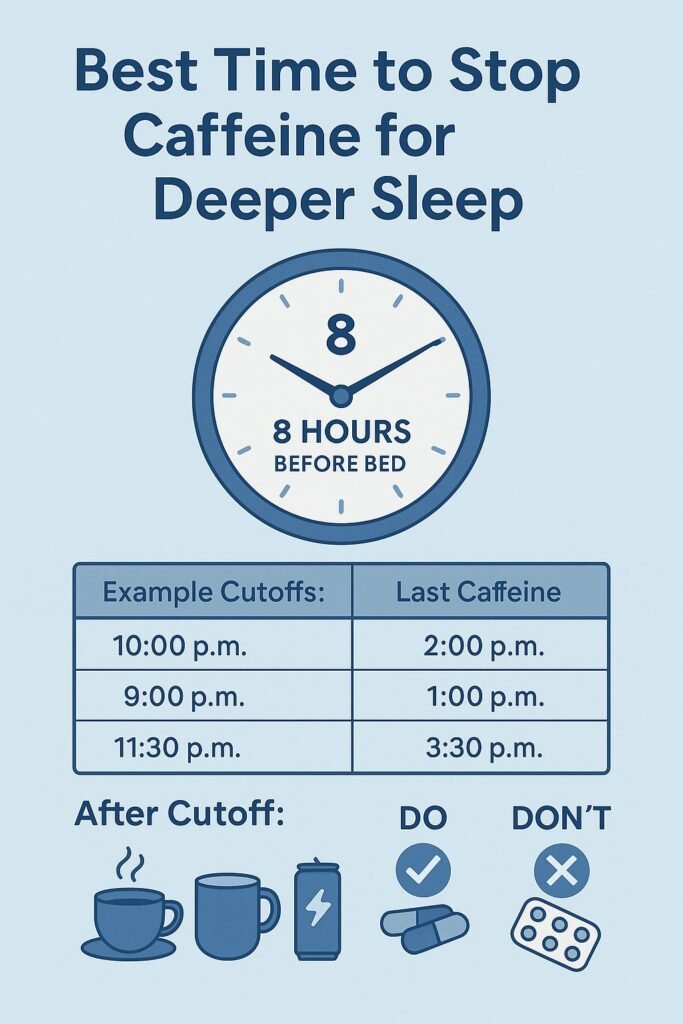
Table of Contents
- Quick Answer: When to Stop Caffeine
- Why Caffeine Hurts Deep Sleep
- How Long Caffeine Lasts (Half-Life Explained)
- The Research on Caffeine Cutoff Times (6–12 Hours)
- Find Your Personal Cutoff (3-Step Method)
- How Much Caffeine Is in Popular Drinks & Pills
- What to Drink After Your Cutoff Time
- Caffeine Timing for Shift Workers & Early Birds
- Smart Habits That Protect Deep Sleep
- Frequently Asked Questions
Quick Answer: When to Stop Caffeine
Most people should stop caffeine 8 hours before bedtime to protect total sleep time and deep, restorative stages. At minimum, avoid caffeine for at least 6 hours before bed; sensitive individuals or heavy users may need 10–12 hours. This range aligns with controlled trials and widely cited sleep-hygiene guidance. PMC+2JCSM+2
Example: If lights out is 10:30 p.m., target your last caffeinated drink no later than 2:30 p.m.; if you’re sensitive, move it to 12:30 p.m. or earlier.
Why Caffeine Hurts Deep Sleep
Caffeine promotes alertness by blocking adenosine, a neurotransmitter that builds sleep pressure throughout the day. When adenosine can’t bind, you feel less sleepy, you fall asleep later, and your sleep becomes lighter with more awakenings—especially if caffeine is taken late in the day. Sleep Foundation
Even if you think you slept fine, objective sleep studies show reduced total sleep time and altered sleep architecture after afternoon or evening caffeine. That’s why people often underestimate the impact on their sleep. PMC
How Long Caffeine Lasts (Half-Life Explained)
- The average half-life of caffeine in healthy adults is ~5 hours, but it ranges widely from about 1.5 to 9.5 hours depending on genetics, hormones, smoking status, dose, medications, and health. Frontiers+3NCBI+3ScienceDirect+3
- Caffeine peaks in the bloodstream about 1–2 hours after consumption and is well absorbed within ~45 minutes. PMC+1
Because two half-lives (about 10 hours for an average metabolizer) leave ~25% of the dose still active, an afternoon coffee can linger at bedtime—and for slow metabolizers, much longer. Genetics matter: variants in CYP1A2 (metabolism) and ADORA2A (sensitivity) help explain why some people sleep fine after dinner espresso while others are wired from a lunchtime latte. PubMed+2PMC+2
The Research on Caffeine Cutoff Times (6–12 Hours)
- A randomized, double-blind, placebo-controlled trial gave participants 400 mg caffeine (≈ large coffee) 0, 3, or 6 hours before bedtime. All three times significantly disrupted sleep, and even the 6-hour dose reduced total sleep time by more than an hour. Conclusion: avoid substantial caffeine for at least 6 hours pre-bed. PMC+2JCSM+2
- Authoritative sleep guidance commonly recommends 8 hours caffeine-free before bedtime to be safe across a range of sensitivities. Sleep Foundation
- Newer evidence suggests higher doses (≈400 mg) can alter sleep architecture if taken within 12 hours of bedtime; lower doses (≈100 mg) are less disruptive but still risky late in the day. People.com
Practical takeaway
- Conservative cutoff: 8 hours before bed.
- Minimum cutoff: 6 hours (supported by lab data).
- If you’re sensitive or consume ≥300–400 mg/day: aim for 10–12 hours.
Find Your Personal Cutoff (3-Step Method)
- Set a trial cutoff = Bedtime − 8 hours.
Example: Bedtime 11:00 p.m. → last caffeine by 3:00 p.m. - Track sleep for 7 nights.
Log sleep onset, awakenings, grogginess, and caffeine dose/time. If you still feel wired or your tracker shows reduced deep sleep, move your cutoff earlier by 1–2 hours. - Adjust by sensitivity factors.
- Slow metabolizer signs: caffeine after noon disrupts sleep; palpitations/anxiety; family history of caffeine sensitivity → choose 10–12 hours.
- Fast metabolizer signs: tolerate a small early-afternoon coffee without sleep impact → 6–8 hours may suffice.
(Genetic differences in CYP1A2/ADORA2A explain much of this variability.) PubMed+1
How Much Caffeine Is in Popular Drinks & Pills
Knowing your dose matters just as much as timing:
- Brewed coffee (8 oz): ~95 mg (varies widely by bean and brew)
- Espresso (1 shot): ~63 mg
- Black tea (8 oz): ~47 mg
- Green tea (8 oz): ~28 mg
- Cola (12 oz): ~22–40 mg
- Energy drinks (16 oz): roughly 54–328 mg, depending on brand
- Caffeine tablets: often 100–200 mg per pill
(Values summarized from FDA/Mayo Clinic and other reputable databases.) PMC+3U.S. Food and Drug Administration+3Mayo Clinic+3
Rule of thumb: Keep total daily caffeine ≤400 mg (healthy adults), and finish it before your cutoff. Some groups (pregnant individuals, certain medical conditions, or on specific meds) should use lower limits—consult your clinician. Mayo Clinic
What to Drink After Your Cutoff Time
When the cutoff hits, transition to low- or no-caffeine options that support relaxation without making medical claims.
- Decaf Coffee (≈2–5 mg/8 oz): Keeps the ritual without the buzz.
Buy Here : Peet’s Coffee Decaf Major Dickason’s Blend, 12 oz - Herbal Teas (caffeine-free): Chamomile, rooibos, lemon balm, and spearmint are popular evening choices.
Buy Here : Traditional Medicinals Organic Chamomile Tea, 16 ct - Magnesium-rich cocoa alternatives (no added caffeine): Choose carob or “sleep” blends labeled caffeine-free.
Buy Here : Four Sigmatic Cacao Mix (Evening), 10 packets - Plain/Sparkling Water: Prevent nocturnal thirst that can wake you—just taper volume the last 1–2 hours to avoid bathroom trips.
Note: Herbal products can interact with medications. Check labels and speak with a healthcare professional if unsure.
Caffeine Timing for Shift Workers & Early Birds
Shift workers often face a double hit: circadian misalignment and mistimed caffeine. Practical pointers:
- Time your largest dose early in the shift; avoid caffeine in the final 4–6 hours before the planned sleep period. Caffeine takes ~30 minutes to kick in and has a 5–6 hour half-life on average, so late-shift cups can echo into daylight sleep. CDC
- Use strategic 10–20 minute naps paired with a small caffeine dose earlier in the shift (“coffee-nap”), not near bedtime.
Early birds who rise at 5–6 a.m. should still delay first caffeine ~60–90 minutes after waking to let natural cortisol rise—then finish caffeine by early afternoon to protect a 9–10 p.m. bedtime (practical guidance consistent with the half-life data above). NCBI+1
Smart Habits That Protect Deep Sleep
Caffeine timing works best alongside a few proven habits:
- Create a wind-down buffer: the last 60–90 minutes before bed should be calm—dim lights, stretch, read, or breathe. AP News
- Avoid large meals and alcohol late: both degrade sleep quality. AP News
- Keep screens dim: blue-light exposure near bedtime can delay melatonin; use night modes or blue-light filters. AP News
- Exercise—just not right before bed: finish workouts ≥3 hours before bedtime. CDC
- Mind hidden caffeine: chocolate, pre-workout powders, “energy” gums/gels, some cold medicines. Check labels. U.S. Food and Drug Administration+1
Helpful sleep-friendly gear (non-medical)
- Gooseneck kettle & timer for precise morning brewing (avoid afternoon refills!).
Buy Here : COSORI Electric Gooseneck Kettle - Evening herbal set for routine building.
Buy Here : VAHDAM Assorted Herbal Teas Sampler - Blackout eye mask to deepen sleep after cutting caffeine.
Buy Here : MZOO 3D Contoured Sleep Mask
(These products support routines; they’re not treatments for insomnia.)
Frequently Asked Questions
Q: Is decaf safe at night?
A: Usually, yes—decaf has a small amount of caffeine (often 2–5 mg per 8 oz). If you’re extremely sensitive, choose herbal teas labeled caffeine-free. Mayo Clinic
Q: I sleep fine with a 4 p.m. coffee. Should I still cut it?
A: You might be a fast metabolizer or simply not noticing lighter sleep. Try a 2-week earlier cutoff and compare how quickly you fall asleep and how you feel in the morning. Genetics and dose matter. PubMed+1
Q: What if I need caffeine to train after work?
A: Use smaller doses earlier (e.g., 50–100 mg), switch to non-caffeinated pre-workout routines (music, warm-up, cool shower), and finish caffeine ≥8 hours before bedtime. High doses closer to bedtime are most disruptive. PMC+1
Q: Is 400 mg/day safe?
A: For most healthy adults, ≤400 mg/day is considered a generally safe upper limit—but late timing can still wreck sleep. Keep your largest dose in the morning and respect your cutoff. Mayo Clinic
Q: Does caffeine help with daytime sleepiness after a bad night?
A: It can improve alertness temporarily, but using it late can create a vicious cycle—poor sleep → more late caffeine → poorer sleep. Use modest morning doses and reset with an earlier cutoff or a caffeine-free day. Sleep Foundation
Bottom Line
If deep, restorative sleep is the goal, timing beats willpower. The science shows that caffeine can impair sleep even when taken 6 hours before bed, and higher doses may echo up to 12 hours later. A practical, protective window is 8 hours caffeine-free before bedtime—earlier if you’re sensitive, pregnant, on interacting meds, or regularly consume ≥300–400 mg per day. Combine that with a consistent wind-down routine and low-stim evening drinks, and you’ll stack the deck for deeper sleep tonight. PMC+2Sleep Foundation+2


Thank you, helpful information. best website