10-Minute Mobility Routine to Instantly Fix Tight Hips and Hamstrings
Tired of nagging stiffness in your hips and hamstrings? You’re not alone. In today’s world, our sedentary lifestyle and long hours of sitting wreak havoc on lower body mobility. But there’s good news: with the right mobility routine to fix tight hips and hamstrings, you can restore flexibility, ease discomfort, and move like a well-oiled machine again.
Outline: Comprehensive Guide on Mobility Routine to Fix Tight Hips and Hamstrings
| Section Title | Description |
|---|---|
| Introduction | Importance of mobility and flexibility for hips and hamstrings |
| Understanding Tight Hips and Hamstrings | What causes them and signs you might be suffering |
| Why Mobility Matters More Than Stretching | Difference between passive stretching and dynamic mobility |
| Benefits of a Daily Mobility Routine | Physical, mental, and performance benefits |
| Top Causes of Tight Hips and Hamstrings | Sedentary lifestyle, poor posture, overtraining |
| The Science Behind Tightness | Fascia, muscular imbalances, and nervous system involvement |
| Posture and Pelvic Tilt’s Role | How anterior/posterior tilt affects mobility |
| How to Assess Your Hip and Hamstring Mobility | Simple tests at home |
| Best Mobility Tools to Support Recovery | Foam rollers, massage guns, resistance bands |
| Amazon Essentials for Mobility Work | Top-rated products and links for convenience |
| Daily 10-Minute Routine | Step-by-step breakdown of effective exercises |
| Dynamic Warm-Up Exercises | Pre-workout moves to unlock tightness |
| Static Stretches to Wind Down | Post-exercise stretches to maintain flexibility |
| PNF Stretching for Advanced Flexibility | How to safely use proprioceptive neuromuscular facilitation |
| Yoga Poses to Open Hips and Loosen Hamstrings | Easy-to-follow yoga flow |
| Breathing Techniques That Support Mobility | The role of breath in muscle release |
| Importance of Hydration and Nutrition | What you eat affects your mobility |
| How Sleep Impacts Recovery | Sleep as a tool for restoring tissue health |
| Weekly Routine Schedule | A sample plan to follow through the week |
| Mistakes to Avoid in Mobility Training | Common errors that slow progress |
| How Age Affects Hip and Hamstring Mobility | Adapting routines for older adults |
| Best Practices for Long-Term Improvement | How to stay consistent |
| Mobility Routine to Fix Tight Hips and Hamstrings: Real User Reviews | Testimonials from those who’ve benefited |
| Professional Help: When to See a Specialist | Red flags you shouldn’t ignore |
| FAQ Section | Common questions answered clearly |
| Final Thoughts and Takeaways | Summary of key action points |
Introduction: Why You Need a Mobility Routine to Fix Tight Hips and Hamstrings
In a world dominated by desk jobs, tight hips and hamstrings have become almost universal. If you’re constantly feeling stiff, struggle with squats, or can’t touch your toes—your mobility is begging for attention. A proper mobility routine to fix tight hips and hamstrings is your first step to regaining pain-free movement, enhancing athletic performance, and improving posture.
Understanding Tight Hips and Hamstrings
Tight hips and hamstrings don’t just appear overnight. Years of sitting, poor movement habits, or intense workouts without adequate recovery can cause these muscles to shorten, tighten, and become restricted. Symptoms include:
- Lower back discomfort
- Limited range of motion
- Difficulty bending or rotating the hips
- Feeling “locked up” after sitting
Ignoring these signs can lead to compensation injuries, chronic pain, and even spinal issues.
Why Mobility Matters More Than Stretching
Stretching pulls on muscles, but mobility trains your joints and nervous system to move freely. Mobility work:
- Enhances joint range of motion
- Strengthens stabilizer muscles
- Improves motor control
- Boosts circulation and nutrient delivery
If you’ve only been stretching and not seeing progress, mobility might be the missing puzzle piece.
Benefits of a Daily Mobility Routine
By committing to a mobility routine to fix tight hips and hamstrings, you’ll notice:
- Improved athletic performance
- Better posture and alignment
- Faster recovery after workouts
- Reduced injury risk
- Increased confidence in movement
This investment in your body pays dividends across your health, fitness, and lifestyle.
Top Causes of Tight Hips and Hamstrings
Let’s uncover what’s causing all this tightness:
- Prolonged Sitting: Chairs shut off glutes and shorten hip flexors
- Poor Posture: Slouching leads to muscular imbalances
- Overtraining Without Recovery: Muscles stay contracted
- Stress and Anxiety: Tension tightens the body
- Lack of Movement Variety: Repetition breeds restriction
The Science Behind Tightness
Your muscles are wrapped in fascia – a fibrous network that can become “glued down” with inactivity. Over time, your nervous system perceives limited mobility as “normal,” resisting stretching. The solution? Gradual, consistent mobility work that re-educates both tissue and brain.
Posture and Pelvic Tilt’s Role
Anterior pelvic tilt (where your butt sticks out) or posterior tilt (tucked hips) both lead to shortened or overstretched muscles. A balanced pelvis = happy hamstrings and mobile hips.
How to Assess Your Hip and Hamstring Mobility
Try these at-home tests:
- Toe Touch Test
- 90-90 Hip Test
- Lunge with Overhead Reach
Can’t pass these? You’ve got work to do.
Best Mobility Tools to Support Recovery
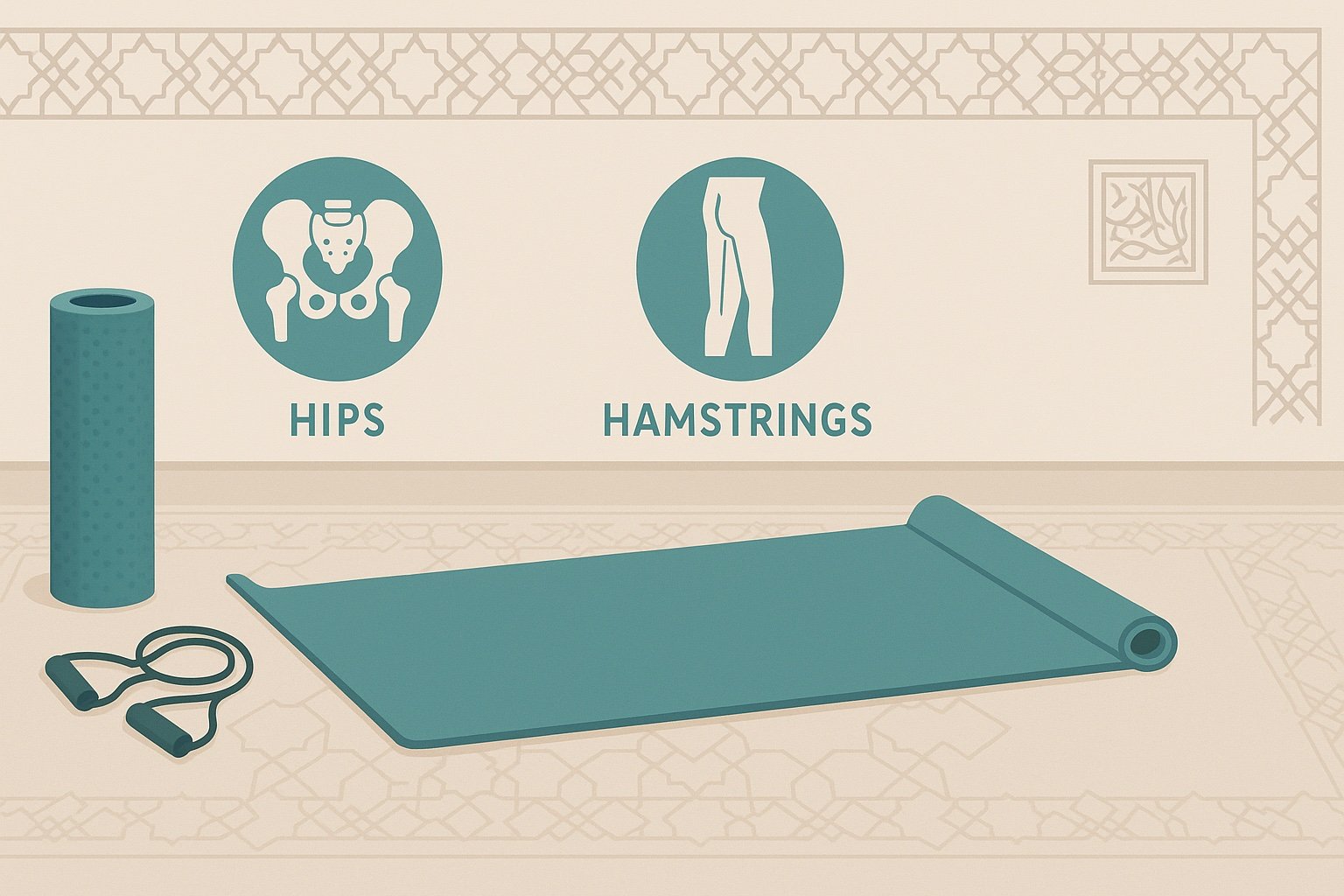
Before we get into the routine, consider using tools to deepen your results:
- Foam Roller: For myofascial release
- Massage Ball: Target trigger points
- Resistance Bands: Add strength to range of motion
- Yoga Blocks: Modify poses safely
- Mobility Stick: Improve alignment and control
Amazon Essentials for Mobility Work
Here are highly rated Amazon products that support your routine:
- 🔗 TriggerPoint GRID Foam Roller
- 🔗 Theraband Resistance Bands
- 🔗 Lacrosse Massage Ball
- 🔗 Manduka Yoga Block
- 🔗 Rogue Mobility Stick
Daily 10-Minute Mobility Routine to Fix Tight Hips and Hamstrings
This flow is designed to fit into your busy schedule:
- World’s Greatest Stretch (1 min each side)
- 90/90 Hip Mobility (1 min each side)
- Hamstring Scoops (1 min)
- Kneeling Hip Flexor Stretch + Reach (1 min each side)
- Glute Bridge with March (1 min)
- Downward Dog to Cobra Flow (1 min)
Repeat daily or as part of your warm-up.
Dynamic Warm-Up Exercises
These activate your hips and hamstrings before training:
- Walking Lunges
- Leg Swings (front-to-back and side-to-side)
- High Knees
- Glute Kicks
- Banded Monster Walks
Static Stretches to Wind Down
Perfect after workouts or before bed:
- Seated Forward Fold
- Pigeon Pose
- Supine Hamstring Stretch (with band)
- Butterfly Stretch
Hold each for 30-60 seconds.
PNF Stretching for Advanced Flexibility
Use a partner or towel for this:
- Contract the muscle for 5 seconds
- Relax and stretch deeper for 20 seconds
- Repeat 3 rounds
Best done 2-3x/week.
Yoga Poses to Open Hips and Loosen Hamstrings
- Low Lunge
- Half Split
- Lizard Pose
- Reclining Hand-to-Big-Toe Pose
- Happy Baby
These poses blend strength, breath, and length.
Breathing Techniques That Support Mobility
Inhale deeply through the nose, exhale fully through the mouth. Use diaphragmatic breathing to signal your nervous system to relax, allowing deeper stretch.
Importance of Hydration and Nutrition
Hydrated muscles = elastic muscles. Focus on:
- Water
- Electrolytes
- Magnesium-rich foods
- Omega-3s for inflammation reduction
How Sleep Impacts Recovery
Aim for 7–9 hours nightly. Your body restores tissue, balances hormones, and resets neurological patterns in sleep. No sleep = no mobility gains.
Weekly Routine Schedule
| Day | Routine Focus |
|---|---|
| Mon | Full Routine + Dynamic Warm-Up |
| Tue | Yoga + Static Stretching |
| Wed | PNF + Foam Rolling |
| Thu | Mobility + Strength Combo |
| Fri | Routine + Breathing Practice |
| Sat | Light Flow Yoga |
| Sun | Rest or Gentle Stretch |
Mistakes to Avoid in Mobility Training
- Rushing through movements
- Not breathing properly
- Stretching cold muscles
- Skipping rest days
- Comparing your flexibility to others
How Age Affects Hip and Hamstring Mobility
Mobility tends to decline with age, but this isn’t destiny. With consistent effort, even older adults can regain and maintain flexibility.
Best Practices for Long-Term Improvement
- Set calendar reminders
- Warm up before every workout
- Incorporate mobility into your lifestyle
- Track your progress
- Celebrate small wins
Mobility Routine to Fix Tight Hips and Hamstrings: Real User Reviews
“After just two weeks of this routine, my squat depth improved dramatically.” — Jake, 34
“I used to get lower back pain daily, now it’s gone.” — Anita, 42
“The combination of yoga and breathing made a huge difference.” — Raj, 29
Professional Help: When to See a Specialist
If pain persists, or you notice:
- Shooting nerve pain
- Tingling/numbness
- Uneven leg length
Consult a physical therapist or mobility specialist.
FAQs
How long does it take to see results?
Usually within 2–4 weeks of consistent daily practice.
Can I do this routine before lifting weights?
Yes, it’s ideal as a warm-up or cool-down.
What if I’m not flexible at all?
Start slow and stay consistent. You don’t need to be flexible to improve mobility.
Can I do mobility training every day?
Absolutely. Just vary the intensity and focus areas.
Do I need equipment?
Not required, but tools like foam rollers or resistance bands can accelerate progress.
Will mobility fix my back pain?
If it’s caused by tight hips/hamstrings, yes. But consult a doctor for persistent pain.
Final Thoughts and Takeaways
A mobility routine to fix tight hips and hamstrings is one of the smartest investments you can make for your body. Whether you’re an athlete, office worker, or somewhere in between, taking 10–15 minutes a day to loosen up will pay off in reduced pain, increased movement quality, and better overall well-being. Flexibility is freedom—so start unlocking it today.
See More : Best lunches to take to work for weight loss: 9 Tips